Return To Office
An isometric office floor for running a fleet of agents — every agent at a desk, every project a room, every action written to an append-only record.
Next.js / W&B Weave / herdr
Problem
Agent observability is something you open when something has already gone wrong. I wanted the opposite: an interface I would open because I wanted to.
The underlying problem is sharper than aesthetics. A fleet of sixteen agents produces far more output than anyone can review, so the only question that matters is which two decisions need a person right now.
Solution
The fleet as an office floor. Each agent is a figure at a desk — Scribe, Researcher, Auditor, Lawyer, Prototyper — and each project is a room they move between. Who is working, who is idle, and where the two failing checks are, without reading a log line.
Underneath the game view it is unglamorous and real: an append-only record of every event, live traces and evals through Weave, a spawn bar that creates agents by role, and a queue of things needing a human to approve or reject.
Analysis
The queue is the actual thesis. Everything else on the screen exists to make one question answerable at a glance, and the isometric floor is not decoration — it is the thing that makes a fleet legible without reading it.
The honest risk is that a game view flatters the operator into feeling informed. The append-only record is the counterweight: the pretty layer sits on top of something auditable rather than replacing it.
Result
Sixteen agents across seven projects, with 12,176 events in the record and two things waiting on a human.
Screens
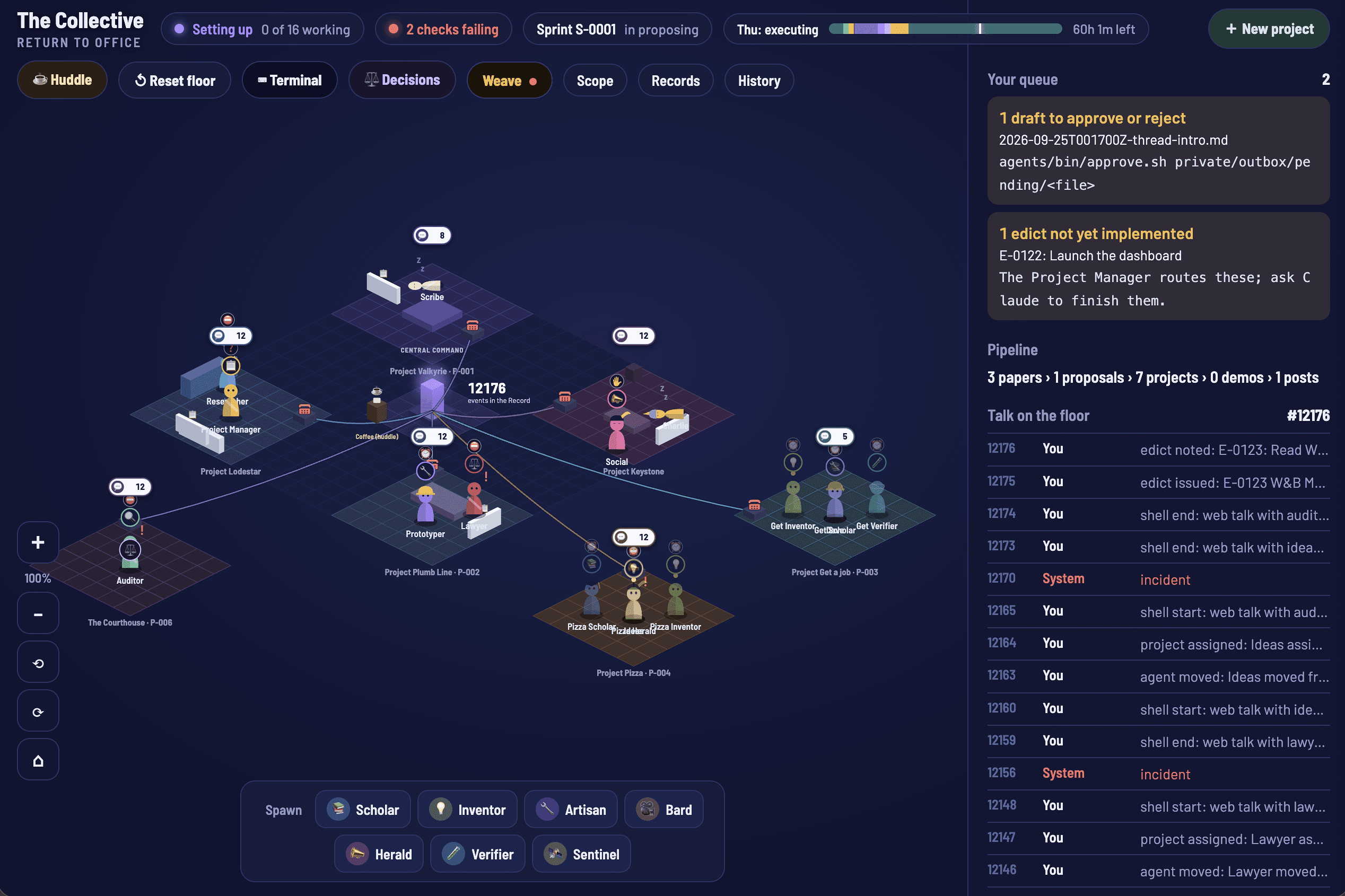
Sixteen agents, seven projects, 12,176 events in the record. The queue on the right is the part that matters — two things waiting on a human.