Verafy
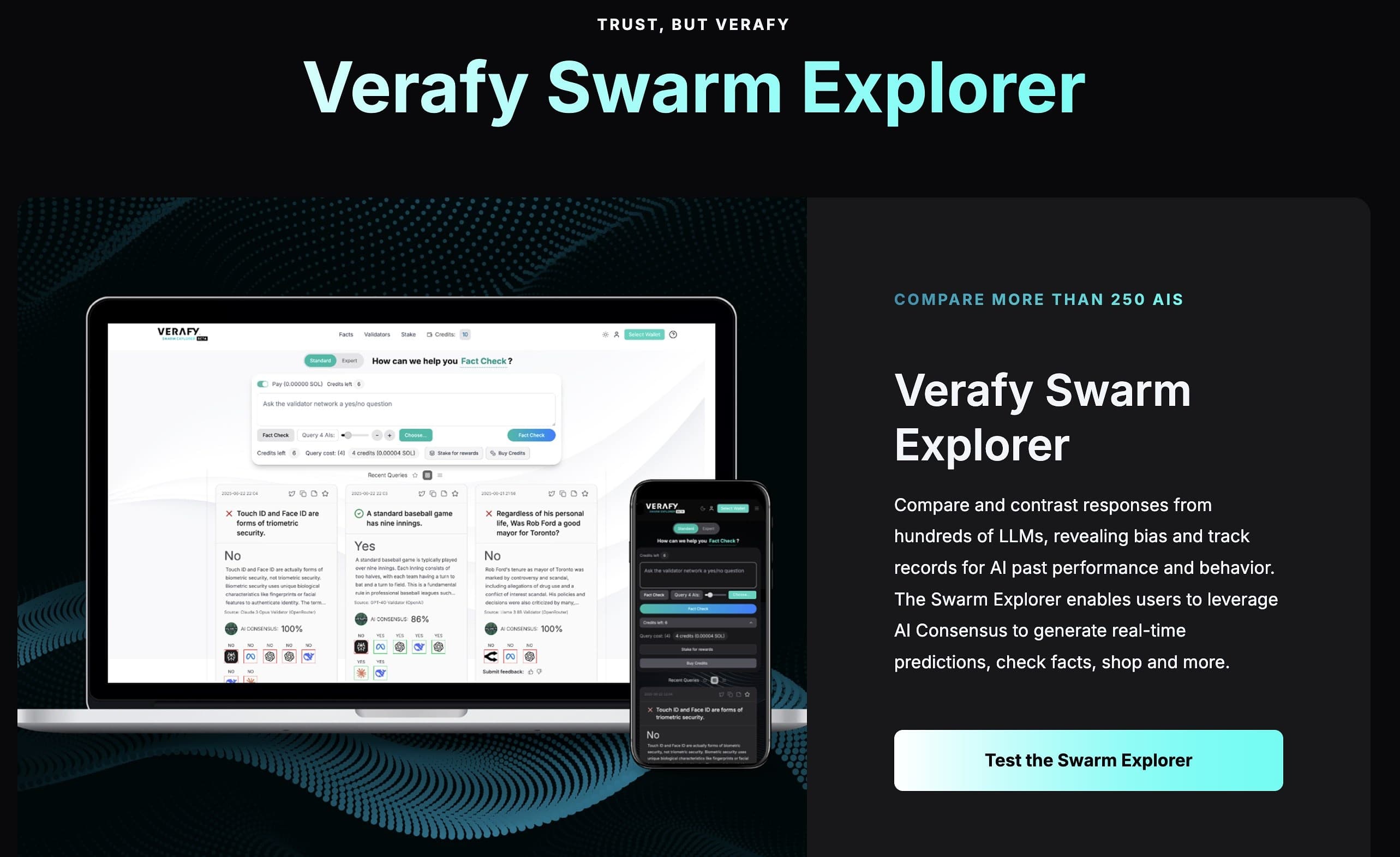
Verafy began as a viral hackathon project and scaled to a $17M capital launch, a Solana validator with 220,000 staked SOL, multiple product launches, and a highly innovative team and community of 4,000. Working with contributors from around the world, we designed and built the ultimate tool for comparing and grounding AI outputs, using LLMs as judges.
Numbers
- $17M
- Launch capitalprimary
- 4,000+
- Developer community
- 250+
- Models comparedvia the Swarm Explorer
- 220,000 SOL
- Delegated stakeon the validator, at its peak
- 6
- Team built
Problem
LLMs were multiplying, and plenty of them were being steered. Sandboxed, cagey, or simply different a month later on the same question. One snapshot of a model's opinion cannot show the trajectory. More truthful, or less. More biased, or less. And where.
I was looking for the real reason to put AI and a blockchain in the same product. A chain can inscribe a record that cannot be deleted, and anyone can check that their copy matches. That was the part worth building on.
Solution
Verafy started as a hackathon project over a winter vacation. I opened ChatGPT and we built Truth Chain, the first demo. It went viral. People asked for a product. About 4,000 showed up in the community, and I recruited the volunteer team from them.
Three pieces. A public catalog of contentious questions, graded by people, so the benchmark is not one a model can dodge. Access to many models, which Hugging Face and OpenRouter mostly solved. And inscription, from IQ, built by Zo, the founder of IQ6900.
We shipped several iterations to get to what is up now. The Swarm Explorer is the hosted panel. The FactCheck extension runs the same check on the page where the claim appears.
Analysis
People have to grade the questions. If a model helps write the test, it can avoid the items that would catch it.
The models also have to rule before they see the rest of the panel. Shown the others first, they converge. The screen looks cleaner and the disagreement is gone. A split is the information. A 93% that four models do not share is a different fact from a 93% they all signed.
The cost arrived in October 2025. The crypto crash wrecked the market and set the work back. A validator at 220,000 staked SOL does not protect the product from that.
Result
Truth Chain was the public proof. The community reached about 4,000 people. The launch raised $17M. The Swarm Explorer compares more than 250 models. Truth Node peaked at 220,000 staked SOL. My Solana Accelerate keynote passed 600,000 views on X.
Then the crash. I took a few months, learned the new tools, and I am taking a second run at it.
Demo
What I built
Truth Chain2025
The holiday hackathon demo. Contested questions go to a panel of models, and the answers are inscribed so the record cannot be edited later. It went viral. About 4,000 people showed up, and the volunteer team came out of that community.
Swarm Explorer
The hosted panel. A claim goes to many models, LLMs judge it, and every verdict keeps a confidence score and a per-model breakdown. Hugging Face and OpenRouter supplied the models. IQ, built by Zo, founder of IQ6900, inscribes the snapshots.
FactCheck
The same check in the browser. Highlight a claim on the page you are already reading.
Truth Node
A Solana validator run end to end — Ansible, shell automation and payment plumbing — peaking at 220,000 staked SOL. The October 2025 crash set the effort back.
Figures
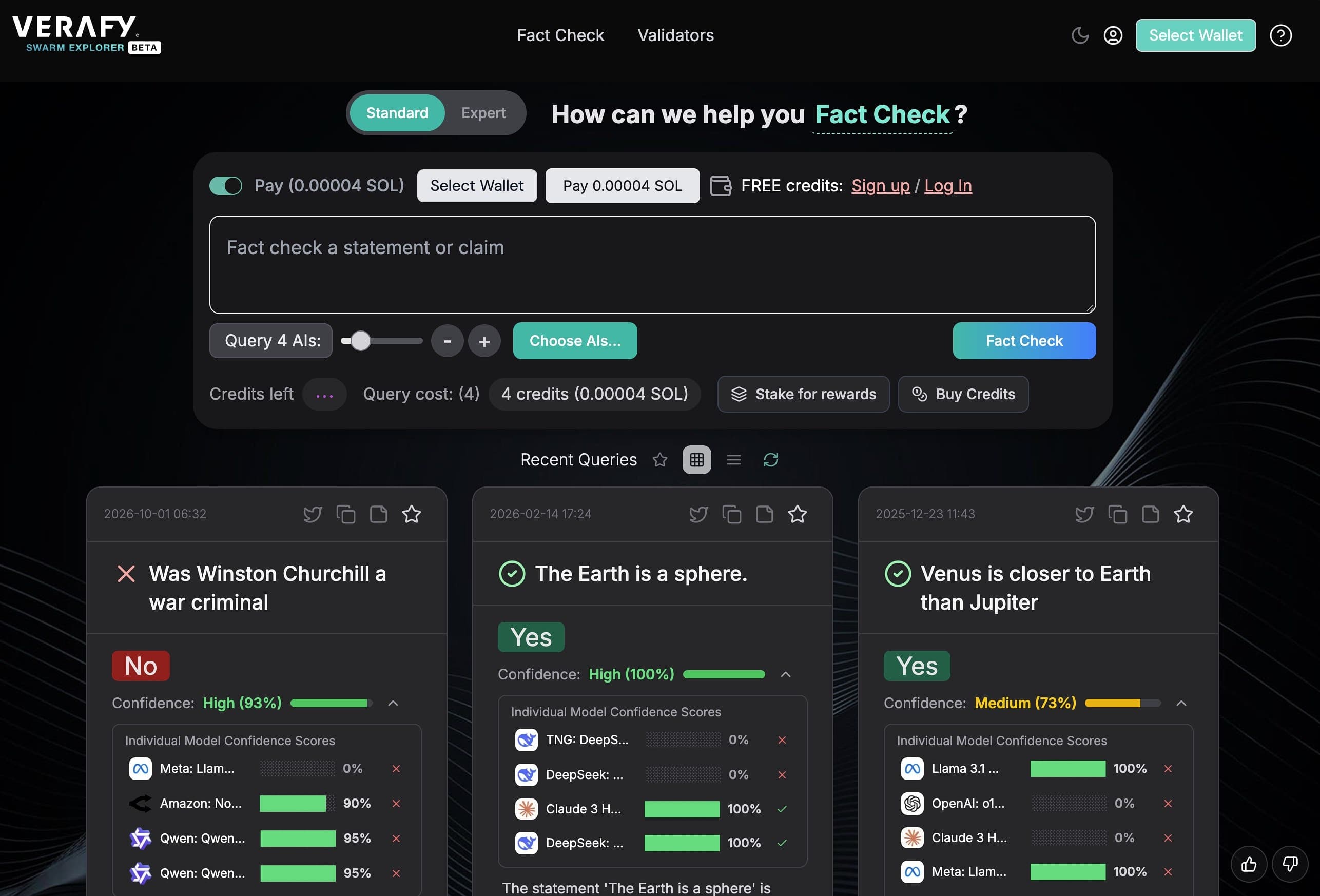
Churchill comes back No at 93%, while Meta's model sits at 0% and Qwen at 95%. A single number would have hidden that.